Maybe you’ve heard about mix bus compression, but have never tried it. Maybe you use it religiously, but don’t quite know why. Or maybe the thought of putting a compressor over your whole mix sounds crazy.
The Helios stayed in Studio 1 until 1984 when it was replaced by an SSL 4000E, the Helios went to the newly acquired Townhouse 3. This early exposure to the SSL bus compressor via the B series in Studio 2 must have fed the desire to have access to a similar bus compressor in the Helios equipped Studio 1. Build Your Own SSL Bus Compressor. Waves SSL G-Master Buss Compressor Tips This compressor does not have a mix knob so be careful with the fast attack settings. You don’t want to kill your transients. Attack settings of.
There’s undoubtedly a lot of confusion amongst mixers on the subject of mix bus compression. Here’s my take on a few commonly asked questions…
Why should I use mix bus compression?
Mix bus compression can make a mix feel more unified and cohesive. It can help glue tracks together and make them sound like they exist in the same space. And with the right release time, mix bus compression can also enhance the groove by pumping in time with the beat.
If you’re going for “wall-of-sound” (think Kings Of Leon), mix bus compression can help you get there. But if you’re aiming for maximum punch and separation (hip hop mixers, listen up), you may get better results without it.
When should I add the mix bus compressor?
My recommendation: the earlier on, the better. If you add a bus compressor near the end of a mix, you’ll risk ruining the balances you’ve carefully crafted.
Try this – after you establish rough balances, pop it in and leave it on.This way, all of your mix decisions will be influenced by the sound of the compressor, and you’ll avoid surprises at the end of the mix. Just keep an eye on your gain staging. If the level into your mix bus changes significantly, you may have to readjust the compressor’s threshold.
It’s important to note that mixing through a compressor feels different than mixing without one. Mixes will tend to come together and gel more quickly. You may find you need less compression on individual tracks. You can be bolder with fader rides, as the bus compressor will push back a bit and reign in your moves.
How do I set the attack time?
A faster attack will round off transients and give you a smoother, more controlled sound. If the attack time is too fast, you’ll lose punch and impact, and your mix will sound soft and distant.
Slower attack times will accentuate transients, adding punch and impact to your mix. This tends to works well for most pop music. If the attack time is too slow, the compressor won’t respond properly to the dynamics of your mix, and it will be rendered ineffective.
Tip: Since the snare is often the loudest transient sound in your mix, you can use it to help you set your mix bus compressor’s attack time. First, set the attack as slow as possible. With your mix playing, speed up the attack time until you notice that the snare starts to lose its punch. Then dial the attack back a bit, and you’re set!
How do I set the release time?
There are three general approaches:
1. Set it as fast as possible without distortion
A fast release time will maximize loudness and add density by bringing up the lower-level details of your mix. This type of setting often works well for high-energy rock tracks.
2. Time it to the tempo of the track
By timing your release to the tempo of the track, your mix bus compressor will pump in time with the beat and enhance the groove. This approach works well for tracks with a prominent, consistent beat (think four-on-the-floor-style EDM).
Tip: Your compressor’s gain reduction meters can help you find the right release time. With the track playing, adjust the release time so that the gain reduction meter just barely returns to 0 before the next downbeat. If you’ve set it right, the needle should bounce in time with the beat of the track.
3. Use auto-release

Auto-release can work well on material with complex dynamics (solo instruments, music that lacks a steady beat), where it may be difficult to find a static release time that works for the whole song.
What ratio should I use?
Lower ratios are more transparent, and tend to work on most material. Higher ratios are more aggressive, and may be more appropriate when you really want to hear the compression.
2:1 is a great place to start. I rarely use anything above 4:1.
How much gain reduction should I aim for?
1 – 2 dB is usually plenty. If you really want to hear the compression working, more may be appropriate.
What kind of compressor should I use?
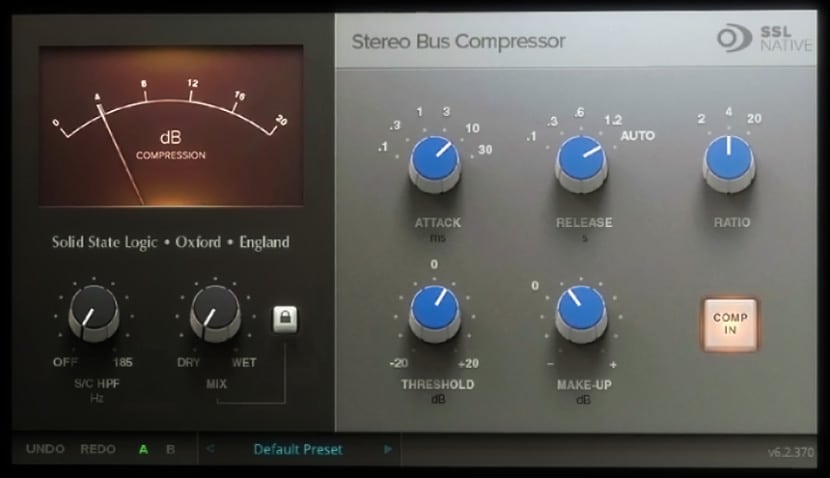
You can’t go wrong with an SSL-style bus compressor. It’s got a bright, snappy sound that pairs well with most modern genres. There are lots of great emulations of this compressor, but my favorite is Slate’s FG-Grey (part of their Virtual Bus Compressors package).
These days, my go-to mix bus compressor is Sonnox’s Oxford Dynamics (designed by Paul Frindle, who built the original SSL bus compressor). It’s more transparent than the SSL, and gives me the sound of compression without the added color and tonal shift.
My mix bus compressor has a high-pass filter. When should I use it?
If your mix has a lot of low end, your bus compressor may start to react in a way you don’t like. You may notice that your mix drops in volume every time the kick hits. Sometimes this pumping effect can sound cool. And sometimes it can sound like crap.
You can use the high pass filter to roll off some of the low end on the compressor’s sidechain (this is the signal the compressor uses to help it determine how much to compress). Since the compressor will “hear” less low end, it will be less sensitive to it. The result? More low end, less pumping.
Note that this filter will only high-pass the signal that the compressor is listening to, not the mix itself!
My mix bus compressor has a mix knob. When should I use it?
If the compression sounds too aggressive, dialing in a bit of dry signal with the mix knob can help tone it down. This can also help restore punch and impact that may have been annihilated by fast attack times. You can often achieve similar results by lowering the ratio or slowing down the attack time.
I hope I’ve given you some useful ideas on how to approach mix bus compression! If you’re looking to dig deeper, I recommend reading the following articles:
Recommended For You:

- inProduction by Bobby Owsinski
There are a number of different types of compressors that every engineer is familiar with, but there’s not a lot of information available about the differences between them and what they’re good at. Most compressor plugins today are based on the four different electronic building blocks that could be used to build a compressor back in the analog hardware days. Here’s a brief look at their characteristics, and what we can do with them.
Optical Style (like the (LA-2A)
A light bulb and a photocell were used as the main components of the compression circuit. The time lag between the bulb and the photocell gave it a distinctive attack and release time. Slow attack and release, use when large transients aren’t present (like vocals). Transparent, tightens up track without being noticed. Adds warmth. Limitations: Won’t control transients, pumps with low end content.
FET Style (like the 1176)
A Field Effect Transistor (FET) was used to vary the gain in the old analog hardware version, which had a much quicker response than the optical circuit. Very fast attack and release with lots of control. Agressive sounding. Best for punch and snap, but adds the most color. Very warm and rich sounding, but won’t work on the mix buss. Limitation: not transparent.
VCA Style (like the dbx 160 or SSL buss compressor)
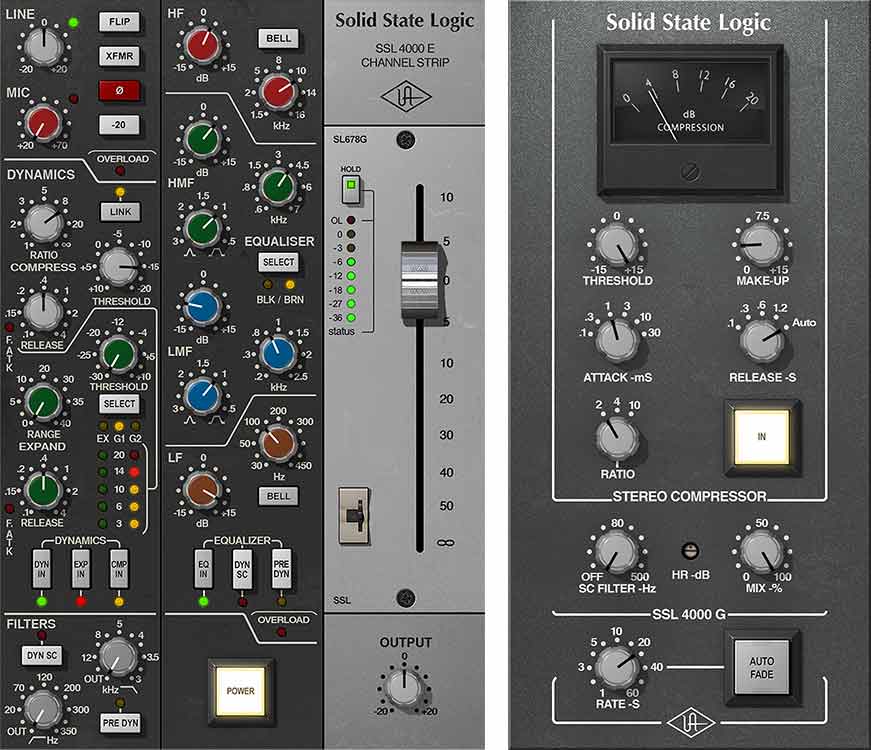
A Voltage Controlled Amplifier (VCA) circuit was a product of ‘80s technology and had both excellent response time and much more control over the various compression parameters. Aggressive sounding with extreme settings and extended parameter functions. Works on the peaks of the program. Use when the transients are already controlled (mix buss). Excellent for adding punch to drums and buss compression. Doesn’t smooth out volume. Limitation: Doesn’t smooth out volume. Can be thin sounding.
Vari-Gain Style (like the Fairchild 670 or Manley Vari-Mu)
The Vari-Gain compressors are sort of a catch-all category because there are other ways to achieve compression besides the first three. Takes time to react, which adds a “glue” to the mix (like the mix buss or subgroup). Ratio increases with gain reduction. The louder the transient, the harder it’s compressed. Good for a mix buss or to add warmth and fatness. Limitation: Slow attack and release. Won’t solve dynamic issues or increase the punch.
Non-Emulation Digital Compressors
While it’s great to make the compressor plugin based on a previous hardware model, today’s digital compressors can do so much more. Almost every developer now has a compressor that goes way beyond what a hardware emulation can do and that results in parameters and sound that never could have been achieved in the old hardware days. Limitation: While some can provide hardware emulation, not many are particularly good at it.
As you would expect, each of the above has a different sound and different compression characteristics, which is the reason why the settings that worked well on one compressor type won’t necessarily translate to another. The good thing about living in a digital world is that all of the different hardware compressor types have been duplicated by software plugins, so it’s a lot easier (not to mention cheaper) to make an instant comparison on a track and decide which works better in a particular situation.
Ssl Buss Compressor Settings Wiring
You can learn more about the basics of mixing with my Mixing Primer Courseor my other courses at bobbyowsinskicourses.com.